"God gave the Torah to the Jewish People so that all nations might benefit from it"
(Midrash Tanchuma)
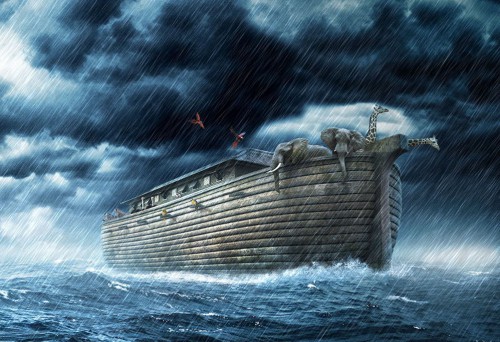
Walking with Noah
By website author Richard Mather
The Torah portion, Noach, (Genesis 6:9-11:32), is an important reminder that any individual, Jew or gentile, has a place in this world and in the world to come.
The story of Noah is particularly important to those gentiles who refer to themselves as B’nai Noach (literally, children of Noah) and follow the Seven Noahide Laws, a set of principles that are a divine blueprint for ethical living.
For thousands of years, there has been a belief that all men and women are bound by a universal code of morality. Following the Deluge, HaShem renews His relationship with creation in its entirety and promises to never again to “cut off” all flesh with the waters of a flood. In return, mankind must behave wisely and justly, and walk with HaShem.
According to Maimonides, six laws were commanded to Adam in the Garden of Eden. These were prohibitions against idolatry, blasphemy, murder, sexual immorality and theft, as well as the commandment to establish laws and courts of justice. To Noah, God reiterated the law against murder and added the prohibition against eating flesh from a living animal, sometimes interpreted as behaving compassionately towards animals.
This universal and ancient code was arguably the faith of Noah, Shem, Abram, Job and possibly even Jethro, Moses’ father-in-law. These great men had strong ethical beliefs, and enjoyed a fruitful relationship with HaShem. Noah’s son Shem, for example, is believed to have been Melchizedek, the King of Salem or Jerusalem. Melchizedek means “my king is righteousness” or “righteousness is my king.” As a priest, Melchizedek brought out bread and wine and blessed both Abram and G-d.
The Seven Laws of Noah were reiterated at Mount Sinai and form part of the 613 commandments given to the people of Israel. The reason for this is simple: the Jewish people were to safeguard these universal principles and to teach them to the nations. In other words, the Jews are a nation of priests tasked with bringing non-Jews into a relationship with HaShem. Jews themselves, of course, have their own particular covenant with HaShem as expressed in the Torah.
Judaism is not a religion which seeks converts. The rabbis clearly teach that non-Jews have the option of following the Seven Laws of Noah. Although conversion is not prohibited (far from it), it makes no difference in terms of that person’s “salvation.” Jew and gentile alike are loved by G-d and judged by their deeds, not by their religious affiliation.
When a gentile resolves to observe the Seven Laws, his or her soul is elevated. According to the rabbis, a non-Jews who commits himself to the Noahide Way becomes one of the “pious ones of the nations” and receives a share of the world to come, as well as blessings in this world.
The Noahide faith has nothing to do with creating another religion, which is forbidden in the Torah, but is about acknowledging HaShem as the One G-d of both Jews and non-Jews, and recognizing that He is a righteous and loving G-d, Who is intimately concerned with His creation.
Noahidism is rapidly gaining in popularity in the West, especially among former Christians who wish to have a relationship with HaShem without the baggage of Christian dogma and two thousand years of Church-sanctioned anti-Semitism. In fact, not since the days of the Second Temple when G-d-fearing gentiles regularly attended synagogues throughout the diaspora, has the Torah played such an important part in the lives of non-Jews.
There are many Noahide groups and communities in the UK, Australia, parts of Europe, and throughout the US. In the early 1990s President George Bush Senior signed into law an historic Joint Resolution of both Houses of Congress recognizing the Seven Noachide Laws as the "bedrock of society from the dawn of civilization.”
Chabad Lubavitch has done the most in recent years to reach out to non-Jews. In 2006, the spiritual leader of the Druze community in Israel met with a representative of Chabad to sign a declaration calling on all non-Jews in Israel to observe the Noahide Laws. A year later, Chabad brought together ambassadors from Poland, Japan, Ghana, Latvia, Mexico and Panama, who all championed the Noahide Laws.
In Manchester, England, where I live, Chabad has been prominent. Hasidic Jews are often seen handing out leaflets to passers-by. There is now a small Noahide study group, which gathers every week to discuss the Torah and Halachic matters. I am glad to say I am one of the participants in this group.
The majority of Noahides are very supportive of the State of Israel and are on the frontline in the fight against anti-Semitism and anti-Zionism in their own countries. Most Noahides have their own blessings and prayers (written by orthodox rabbis) and have turned away from pagan holidays such as Christmas and Easter. Some Noahides attend synagogues and most, if not all, study under trained rabbis. In 2005, the scholar Rabbi Moshe Weiner of Jerusalem started work on an in-depth codification of the Noahide precepts. Published three years later, Sefer Sheva Mitzvot HaShem (“The Book of Seven Divine Commandments”) has been approved by the chief rabbis of Israel, as well as other halachic authorities.
As a Noahide I am proud to be part of a growing movement which seeks to restore the faith of Noah and Shem. I am also gratified to be considered a friend of the Jewish people and the State of Israel. But mostly I am glad to have heeded Jeremiah 6:16, which speak of a journey of righteousness and a life of fidelity towards HaShem: “This is what the Lord says: ‘Stand at the crossroads and look; ask for the ancient paths, ask where the good way is, and walk in it, and you will find rest for your souls’.” The Noahide Way truly is the ancient path.
https://www.israelnationalnews.com/Articles/Article.aspx/12344
Noahides and the celebration of Passover
Religious holidays can be strange times for Noahides or B’nai Noach. As a Noahide living in Britain, I do not observe Christian festivals like Easter and Christmas and yet I am cut off from Jewish festivals such as Passover, partly because there are no Noahide customs to speak of and partly because I live nowhere near a synagogue.
Noahides follow the Noahide Way, a divine moral code (given to Adam, Noah and Moses) which commands the establishment of courts of justice and prohibits idolatry, blasphemy, murder, sexual immorality, theft and cruelty to animals. However, Noahides are not supposed to create new religious festivals, nor are they allowed to observe Jewish religious holidays in the manner of their Jewish brethren.
During Passover, Noahides find themselves in a quandary. How to observe this important holiday without trespassing on Jewish traditions? The general rule is that Noahides are allowed to observe Passover, the Sabbath and other holidays to some extent on the understanding that such observances are not commanded by G-d. In short, a Noahide has the option of commemorating Passover in a modified way, if he or she chooses to do so.
In his book The Divine Code, Rabbi Moshe Weiner reiterates the rabbinical prohibition of setting aside any day for a specific religious observance or statute. However, a Gentile is allowed to eat unleavened bread or sit in a sukkah booth if he does it “for his own satisfaction” and “is not establishing a festival for himself.”
So the removal of chametz is not required of Noahides but there are things Noahides may do in order to appreciate the spirit of Passover, such as spring cleaning, donating to charity, reading the exodus story or having a meal with family and friends, which is the suggestion of Rabbi Yoel Schwartz, from the Jerusalem Court for Bnei Noah.
So, spring cleaning, reading Torah or having a meal with friends are all possibilities for the Noahide. As long as he or she does not establish any ritual observances or establish any customs, it is appropriate to commemorate in some fashion the liberation of the Israelites.
But I am more persuaded by another of Rabbi Schwartz’s suggestions, which is to contemplate the concept of human freedom. The exodus from Egypt, says the rabbi, profited Jew and Gentile alike in that it was “a cleansing from the bad habits of mankind.” Obviously, bad habits like theft and immorality are prohibited by the Noahide code. And a non-Jew who cleanses himself from such “bad habits” and commits himself to the Noahide Way becomes one of the “pious ones of the nations” and earns himself an eternal portion in the World to Come.
Freedom is one of those words that mean different things to different people. As a journalist, I am thankful I live in a country (the UK) where there is freedom of the press. I am also thankful I am not enslaved by a Pharaoh or a Hitler. On the other hand, too much freedom can be dangerous. Allowing Iran or Hamas or North Korea to act with impunity, for example, endangers the freedom of Israeli and American civilians.
There is a difference between liberty and license, which is why G-d commanded the establishment of courts of law. Justice, when it is working properly, protects rather than hinders freedom. So it right and just that murderers, rapists and terrorists have their freedom taken away. But this raises all kinds of issues such as why did G-d create a world in which good and evil can operate freely?
The standard answer is that He gave us free will. And although He urges us to “choose life” (Deuteronomy 30:19), we have the choice to do otherwise. But even when we “miss the mark” or “go astray” there is the possibility of repentance, of turning towards Him and following his divine plan for goodness and kindness. Passover is an excellent time to remember G-d’s power to punish and redeem. Even His punishment of the Egyptians is part of a wider redemptive plan – to liberate the Israelites and turn them into a light unto the nations.
Indeed, one of the reasons Passover is so important is because it is a prelude to the giving of the Torah, which incorporates and expands upon the Seven Noahide Laws. Indeed, Noahides observe the seven laws because they were commanded at Sinai and not because Adam or Noah received them previously. Also important is the fact that HaShem revealed the Torah. This is crucial because a Noahide is only considered righteous if he accepts the seven Noahide laws as coming from G-d. If he derives the laws from his own intellect, he is not considered righteous.
Finally, the exodus is worth contemplating because it is symbolic of the truth that there is no other authority in the universe. Pharaoh’s power is limited, narrow and corrupt – a parody of HaShem’s unlimited and righteous kingship. Both Jews and Noahides proclaim HaShem’s uniqueness, unity and authority. As Rabbi Moshe Weiner states, “it is a continuous obligation for every person to think about and contemplate the existence of the Master of the universe and His greatness, in order to set the knowledge of G-d strongly in his heart and mind.”
King David summed it up when he said, “The LORD is beneficent in all His ways and faithful in all His works.” G-d’s goodness and His immense love for the Israelites were demonstrated during the first Passover and the subsequent giving of the Torah. It is the same belief in G-d’s goodness and power that sustains the faith of Noahides who believe that everything HaShem does is for the ultimate good of the individual and the good of the entire world.
So, for this Noahide at least, Passover is about contemplating G-d’s gift of freedom, His goodness and His faithfulness towards Jew and Gentile alike. Maybe next year I’ll do some spring cleaning.
https://www.israelnationalnews.com/Articles/Article.aspx/13069#.UVhCrFdTlog
What does Yom Kippur mean to Noahides?
The Talmud states that Yom Kippur atones for those who repent but it does not atone for those who don’t repent. How does this apply to Noahides who are not expected to attend synagogue or fast for 25 hours? Do Yom Kippur and the preceding Days of Awe apply to Noahides at all?
Noahides are gentiles who observe the Noahide Way, a universal moral code which comprises the six commandments given to Adam (according to the Talmud's interpretation of Genesis 2:16) and a seventh precept, which was given to Noah after the Flood. This ancient code was the faith of Noah, Shem, Abram, Job and possibly even Jethro, Moses’ father-in-law. These great men had strong ethical beliefs, and enjoyed a fruitful relationship with G-d. Shem, for example, is believed to have been Melchizedek, the King of Salem or Jerusalem, who brought out bread and wine and blessed both Abram and G-d.
Returning to the subject of Yom Kippur, Rabbi Yoel Schwartz (a senior lecturer at Dvar Yerushalayim yeshiva in the Jerusalem neighborhood of Har Nof) agrees that it is not a Noahide fast. However, he does say that repentance is indeed a Noahide necessity. So how do Noahides, who are not supposed to imitate Jewish festivals or create new ones, earn Hashem’s forgiveness for wrongs done to Him and to people?
The Tanakh tells us that repentance is available to everyone. The Book of Jonah, which is the Haftarah for the afternoon of Yom Kippur, is a crucial text for Noahides because it relates Hashem’s concern for the inhabitants of Nineveh – all of whom were gentiles. Despite Jonah’s reservations, the Ninevites eagerly accept his message of repentance. As a result, the gentiles of Nineveh are spared destruction.
The simplicity of the Ninevites’ repentance, as well as the abundance of G-d’s mercy, is wonderful. The king of Nineveh takes off his royal robes, covers himself with sackcloth and sits in the dust. He calls on his people to stop eating and drinking, and to renounce violence and corruption. The king urges the Ninevites to call on G-d. And as it says in the Bible, when Hashem saw how the Ninevites turned from their evil ways, He relented.
During Yom Kippur Noahides are not required to cease eating and drinking like the Ninevites. But Judaism’s holiest day is a timely reminder for Noahides to make amends with other people and to seek forgiveness from G-d, whom we should thank for His benevolence. Prophet Isaiah tells us to “seek Hashem when He can be found; call upon Him when He is near” (55:6). If Yom Kippur is the time when Hashem is “near” to man, it is a good opportunity for Noahides to ask for forgiveness and to make a mental note not to keep making the same mistakes.
Isaiah’s words echo Leviticus 18:5 in which Hashem commands the Israelites to “guard my statutes and my laws which, when a man [Ha-Adam] does them, he shall live through them.” Notice how G-d says “man” rather than “Israelite.” So what statutes are men expected to keep? For the Jews, it is the 613 mitzvot. For non-Jews, it is the Noahide Way, which commands the establishment of courts of justice and prohibits idolatry, blasphemy, murder, sexual immorality, theft and cruelty to animals.
Of course, very few Noahides will have committed an outright act of theft, for example. But the prohibition against theft – like the other Noahide Laws – is actually a category heading under which a number of smaller commandants are compiled. For instance, the injunction against theft includes refraining from cheating (“You shall not defraud your neighbor” – Leviticus 19:13) and not using false weights and measures ("You shall do no unrighteousness in judgment, in length, in weight, in quantity” – Leviticus 19:35). Depending on the rabbinical authority, there are not just seven laws, but 30 or even 66 commandments which Noahides are expected to keep.
And of course, there are minor transgressions, such as gossiping, ignoring a beggar in the street, lying to our wives, husbands and employers, etcetera. Given time to reflect, most of us would acknowledge that we are guilty of something and that some kind of redress is required – an apology, perhaps, or donating money to a charity for the homeless. Obviously, we don’t have to wait for the Days of Awe and Yom Kippur to make amends but the High Holy Days are a great opportunity to amend our behavior and seek forgiveness for wrongs done.
Because Yom Kippur atones for sins against G-d and not for sins against man (unless the injured party has been appeased), Noahides must earnestly seek forgiveness from others by making amends and making any necessary restitution. Part of the process of teshuva (repentance, literally “returning”) is acknowledging the emotional anguish our words and actions may have caused. As well as easing our conscience, teshuva brings a person closer to Hashem, especially if our repentance is rooted in love of G-d rather than fear. When someone repents out of love, his or her sins are counted as virtues.
In other words, teshuva is transformative because it turns our intentional sins into merits. Indeed, some rabbinical authorities argue that the repentant sinner is greater than someone who has never committed a sin.
So as Jews gather in synagogues to recite the Kol Nidrei prayer, Noahides may want to reflect on their own faults and moral failures, and ask G-d for His forgiveness. And if that person is truly sorry and has sincerely tried to make amends, then Hashem is sure to show His mercy. And G-d willing, that person will be inscribed in the Book of Life and be granted a happy new year.
https://www.israelnationalnews.com/Articles/Article.aspx/13812#.UjQvs8Y3uSo
“Even a gentile who studies Torah is like a high priest” (Sanhedrin 59a)

"There is one God from whom emanates one morality for all humanity. God's primary demand of people is that they act decently toward one another. If all people subscribed to this simple belief—which does not entail leaving, or joining, any specific religion, or giving up any national identity—the world would experience far less evil. […] The God of ethical monotheism is the God first revealed to the world according to the Jewish Bible."
- Dennis Prager, “Ethical Monotheism"



The Cosmic Covenant
And it came to me all in a feeling how everything fitted together, this place and ourselves and the animals and the tools, and how the sky held us.
– Wendell Berry, A World Lost
The cosmic covenant — what Isaiah calls the covenant of peace — is, in Robert Murray’s terms, “the belief in a divinely willed order harmoniously linking heaven and earth.” Murray casts this covenant as a kind of marriage: a union binding heaven and earth, God and Israel, into a single relational fabric. This bond, he argues, is not merely historical but primordial. It is established at Creation itself, “when the cosmic elements were fixed and bound,” when the world’s structure was shaped as an ordered, relational whole.
There was, in other words, an ancient conviction that God actively held the universe in place, sustaining the fragile boundary between chaos and order. Creation was not a one-time event but an ongoing act of divine attention. In Kabbalistic thought, this remains true even now: God is continually upholding the world, and should His gaze falter for even an instant, the universe would collapse back into absolute nothingness. In short, existence itself hangs on the constancy of divine regard.
The Tanakh or Hebrew bible plays repeatedly on the verbal stem ‘rr, whose core meaning is to restrain, bind, or hold fast. Across the Tanakh, this root becomes a subtle theological signal. Evidence of God’s primordial binding of Creation — His securing of the world against chaos — appears in text after text, echoing the belief that the cosmos endures only because it is held in place by divine constraint. “I placed the sand as a boundary for the sea, the eternal rule which it may not transgress,” God asserts in Yirmeyahu [Jeremiah].
The binding of chaos is even more explicit in Iyov [Job]:
“Who shut up the sea behind doors when it burst forth from the womb, when I made the clouds its garment and wrapped it in thick darkness, when I fixed limits for it and set its doors and bars in place, when I said, ‘This far you may come and no farther; here is where your proud waves halt’?”
The cosmic covenant, however, was never immune to the distortions of human sin. Put differently, moral evil can precipitate natural evil, loosening the very bonds that hold heaven and earth in harmony. When humanity violates the moral order, the fabric of Creation itself strains; the covenantal ties that restrain chaos begin to fray. The Flood becomes, in this idiom, an act of divine purgation — a cleansing of a world that had ruptured the cosmic covenant before God could reestablish it with Noah. The loosening of Creation’s primordial bonds is thus not arbitrary but a direct expression of God’s revulsion at human corruption. B’reshith [Genesis] states plainly that “the earth was corrupt in God’s sight and was full of violence.” Other passages describe the world as filled with robbery or plunder, a way of saying that social harmony had collapsed entirely. Humanity had abandoned the universal moral order entrusted to it, and the world, no longer bound by righteousness, slipped back toward chaos.
Although God could have wiped out Creation entirely, He instead commands Noah to preserve a remnant — himself, his family, and a representative sample of all living creatures — by constructing a vast ark, a kind of floating sanctuary. Only after this refuge is prepared does God unleash the overwhelming floodwaters. The act of destruction is thus framed by an act of preservation: judgment tempered by the safeguarding of life, ensuring that the cosmic covenant can be renewed rather than annihilated:
The waters rose and covered the mountains to a depth of more than fifteen cubits. Every living thing that moved on land perished — birds, livestock, wild animals, all the creatures that swarm over the earth, and all mankind. Everything on dry land that had the breath of life in its nostrils died. Every living thing on the face of the earth was wiped out; people and animals and the creatures that move along the ground and the birds were wiped from the earth. Only Noah was left and those with him in the ark.
Not only do most living creatures lose God’s protection during the Flood, but the entire earth is overwhelmed by chaos: land and water collapse into one another, the primordial elements thoroughly intermingled. In effect, the separation of matter achieved at Creation is undone. The ordered world dissolves back toward its pre‑cosmic state, a sign that the covenantal bonds holding the universe together have been temporarily released.
It is no accident that so many Jewish practices revolve around keeping things distinct — meat from milk, Israel from the nations, Sabbath from the weekday. These separations are not merely ritual; they echo a deeper cosmological grammar. Creation unfolds through acts of division and boundary‑making, the carving of order out of undifferentiated chaos. Jewish tradition, in turn, mirrors that primordial structure, preserving in daily life the separations that sustain the world’s harmony.
In David Rosenberg’s translation of the first book of the bible, this theme is brought sharply into focus:
“Since you did this,” said Yahweh to the snake, “you are bound apart from the flocks, from any creature of the field, bound to the ground, crawling by your smooth belly.”
And:
“They conceive this between them until no boundary exists to what they will touch.” […] From there Yahweh scattered them over the whole face of the earth; the city there became unbound.
And:
“The people will be a boundary, warn them to watch themselves, approach but not climb up, not touch the mountain. For those who overstep boundaries, death touches them, steps over their graves.”
The Flood enacts the collapse of the ordered world into chaos; its aftermath, as the waters slowly withdraw, mirrors the original act of separation in B’reshith [Genesis], when dry land first emerged from the deep. In a sense, God had remade the world, and a new covenant was therefore required. The post‑deluge covenant with Noah becomes a formal re‑ratification of the universal created order — a renewed guarantee that the cosmos will hold. Tehillim [Psalms] puts it this way: God sets a boundary for the waters so that they “might not again cover the earth.” After the Flood’s unbinding of Creation, the re‑establishment of limits is itself a divine promise: the world will not collapse back into chaos unless God wills it.
So God blesses Noah and his sons, and makes a pledge with humankind and the animal kingdom, in which He promises to never again to “cut off” all flesh with the waters of a flood. In exchange, Noah and his sons are commanded to be fruitful, to multiply, and to replenish the earth. God also prohibits the consumption of animal blood — an injunction sometimes read as a curb on animal cruelty — and forbids the shedding of human blood. In this renewed world, ethics, natural justice, and the cosmic covenant form a single architecture of order.
II
The prophets were painfully aware of the relationship between sin and chaos. Injustice is never merely a social failure; it destabilizes the very harmony of Creation. For them, personal behavior, the moral life of the nation, and the stability of the cosmos are interdependent. In Hoshea [Hosea], for example, God accuses the people of murder, stealing, lying, and adultery; indeed, they are guilty of having broken the covenant, with dire implications for humanity and the planet: “Because of this the land dries up, and all who live in it waste away; the beasts of the field, the birds in the sky and the fish in the sea are swept away.” Although this moment does not constitute an eschatological rupture like the Flood, it still exposes the covenant’s inherent vulnerability. It hints that, even with God’s pledge to Noah, human sin carries a kind of inexorable momentum — a logic capable of straining the bonds that hold Creation in order.
The prophet Yirmeyahu, too, sees that humanity’s breach of covenant is nothing short of disastrous. In his vision, the collapse of moral obligation threatens the stability of Creation itself, reopening the question of whether the post‑Flood guarantee can hold when human sin gathers enough force to strain its foundations:
I looked at the land — it was unformed and void — and at the sky — it had no light. I looked at the mountains, and they shook — all the hills moved back and forth. I looked, and there was no human being; all the birds in the air had fled. I looked, and the fertile fields were a desert, all the land’s cities were razed to the ground at the presence of Adonai, before his burning anger.
The rupture of the covenant, while unleashing devastation upon the natural world, also unfolds along a political axis. By necessity, when Creation is imperiled, so too is the historical and spiritual future of Judaism and Israel, for their survival is bound to the ongoing maintenance of that covenantal bond. In this sense, cosmic disorder and national destiny are intertwined narratives in the same covenantal drama:
“If you can break my covenant with the day and my covenant with the night, so that day and night no longer come at their appointed time, then my covenant with David my servant – and my covenant with the Levites who are priests ministering before me – can be broken and David will no longer have a descendant to reign on his throne.”
Conversely, the faithful keeping of the covenant carries with it the promise of overflowing plenty. In Vayikra [Leviticus], God pledges that if Israel preserves the moral and natural boundaries of Creation, their labor will be met with unbroken fruitfulness: threshing will run into the grape harvest, the grape harvest into the season of sowing, and they will “eat all the food [they] want and live in safety” upon their land. Here, covenantal fidelity becomes the condition for sustained abundance — ethical order and agricultural flourishing bound together in a single vision of harmony:
“I will look on you with favor and make you fruitful and increase your numbers, and I will keep my covenant with you. You will still be eating last year’s harvest when you will have to move it out to make room for the new. I will put my dwelling place among you, and I will not abhor you. I will walk among you and be your God, and you will be my people.”
In a similar vein, the biblical prophets (despite their fierce warnings) also hold out the promise of hope. They repeatedly envision a future in which God delivers Creation and restores it in full. Their books are filled with images of a world made whole again — a time when humanity and nature are no longer estranged but reconciled within a renewed order. Yekhezqel [Ezekiel], for example, puts it this way:
“I will make a covenant of peace with them and rid the land of savage beasts so that they may live in the wilderness and sleep in the forests in safety. I will make them and the places around my hill a blessing, and I will cause the rain to fall when it should — there will be showers of blessing.”
And this from Hoshea [Hosea]:
“[...] I will make a covenant with them, with the animals of the wild, with the birds of the sky and what creeps on the ground. I will break bow, sword and war on earth, and I will let them rest in safety I will make thee mine own forever; I will make thee mine by right and justice, by loyalty and compassion, I will make thee mine by faithfulness, and thou shalt know [that I am] the Lord.”
Of course, it is only right to ask how many covenants there can be, and what becomes of them if they are repeatedly broken. Rabbinic tradition wrestles with this anxiety. The resolution, it seems, lies in the emergence of an idealized Davidic king — whose righteousness binds moral order and cosmic order into a restored harmony. The seventy-second chapter of Tehillim [Psalms], for instance, offers a glimpse of this vision:
Endow the king with your justice, O God, the royal son with your righteousness. May he judge your people in righteousness, your afflicted ones with justice. May the mountains bring prosperity to the people, the hills the fruit of righteousness. […] May grain abound throughout the land; on the tops of the hills may it sway. May the crops flourish like Lebanon and thrive like the grass of the field.
Judaism reads this as a messianic portrait, but in a distinctively rabbinic register: not a prophecy of a supernatural Jesus, but an elevated vision of David’s hopes for his son, Solomon. Yet the poem’s language quickly outgrows any historical king. Its horizon expands toward an ideal Davidic ruler whose reign is transformative enough to restore the bonds of Creation. In this vision, the cosmos is morally responsive, justice has cosmological force, and the king’s righteousness becomes a microcosm of God’s own governance of the universe. It is therefore not merely a royal prayer; it is a picture of Creation healed through justice — a world in which nature flourishes because moral order is upheld.
In the end, the cosmic covenant reveals itself as the deep grammar of biblical theology — a vision in which Creation, morality, and history are bound together. The universe is not a neutral backdrop but a responsive order that is repeatedly put under by human wrongdoing. From the Flood to the prophets, the Tanakh insists that ethical life is cosmological: justice, charity, and peace stabilize the world, while violence, lying, and corruption loosen the bonds between heaven and earth. Rabbinic tradition addresses the persistent anxiety of covenantal rupture by articulating the hope for an ideal Davidic king, a figure whose unimpeachable righteousness reconstitutes the moral and cosmic order. Within this messianic horizon, the cosmic covenant emerges not merely as a divine assurance but as the normative framework through which a restored cosmos is secured and sustained.
All the World Was Broken [blank verse version]
4th October - World Animal Day
Light and more light: the first of days began.
To soar on weightless wings of air, God made
Fair barbary doves and cocksure ravens,
And mighty condors wheeling through the sky.
For broad grass prairies he made wild sheep there,
And bison strong of shoulder, white-tailed deer.
For forests too he fashioned eucalypts
And firs still green with dark and purple cones.
He measured out the oceans and decreed
The rain, then lowered to the deepest seas
The white whale and the starfish flecked with silver.
Light and more light: once more God fashioned Man
Upon the sixth day; to him was assigned
The care and preservation of the earth;
To tend the vine and free the tangled bird;
To comfort calves brought low by orphaned grief,
And spare the aged hen; and through such work,
By answering well the labour asked of him,
Man would exalt and so perfect himself,
His race as well, and thus through worthy deeds
Inherit power to fashion worlds anew.
But all too soon the angels sang alarm.
Man had run wild, like swarming bacteria
Within a scientist's petri dish, there
Forming and swarming on the jellied agar.
Forests of fir and pine were all ablaze,
And tallest eucalypts became a pyre.
The whale lay cut to pieces; slick with oil
The condor drifted. Seas were soon depleted,
And all the air was caked with pollutants.
All the world broke, and God was filled with grief
That he had made mankind; his heart was troubled.
And Man, who once had fallen far, fell more
Until there was no remnant of the world,
Nor any trace of Man, whose final heirs
Could only dream of settling the stars.
And though the power to fashion worlds remained
With God, he never made another world,
For he had lost all faith in judgement's claim;
The cosmos then grew cold, and colder still,
And all the stars went out one by one.